How Much Does a Travel Agency Website Cost in 2026?

12 min read
- > Key Takeaways:
- > Why Do Travel Agency Website Prices Vary So Much?
- > What Actually Determines the Cost?
- > A Real Travel Website Example: LINES
- > Konstantina, founder of LINES, shared:
- > Cheap vs Expensive: How Much Should You Actually Spend?
- > What Should Be Included in a Professional Travel Agency Website Quote?
- > Common Questions
- > Want a New Website for Your Travel Agency?
If you ask five agencies how much a travel agency website costs, you may receive five completely different answers. One might quote €2.000, another €6.000 and another €20.000. Surprisingly, all three prices could be reasonable.
The reason is simple: a “travel agency website” can describe completely different digital products. A boutique agency that creates tailor-made trips and generates enquiries doesn't need the same website as a tour operator processing hundreds of online bookings. A company selling luxury experiences internationally will also have very different design, content and multilingual requirements from a small local agency that mainly needs an online presence.
So, how much should you actually budget in 2026? A basic DIY solution can cost only a few hundred euros per year, while a professionally designed travel website will typically require an investment of several thousand euros. More sophisticated platforms with booking systems, payments, availability management and custom integrations can easily move into five figures.
The important question isn't simply “How much does a travel agency website cost?” It is “What does my travel business actually need the website to do?”
As a general 2026 benchmark, you can expect approximately:
- DIY or website builder: €10–€100+ per month
- Simple professional travel website: €2,000–€4,000+
- Custom travel agency website: €4,000–€10,000+
- Advanced website with booking functionality: €8,000–€20,000+
- Complex travel platform or custom booking system: €20,000–€50,000+, potentially significantly more
These shouldn't be treated as fixed price lists. The final investment depends heavily on design, number of destinations and pages, content, languages, SEO, booking functionality, integrations and the level of custom development required.
Why Do Travel Agency Website Prices Vary So Much?
A five-page website presenting an agency, several destinations and a contact form is fundamentally different from a platform that allows travelers to search availability, configure a trip, create an itinerary, pay online and receive an automated booking confirmation.
Yet both can be described as a “travel website.”
This is why comparing quotations based only on the final price can be misleading. When evaluating proposals, you need to understand what is actually being designed and developed.
A useful starting point is to divide travel websites into three broad categories.
1. Simple Travel Agency Website: Around €2,000–€4,000+
This is primarily a presentation and lead-generation website. It might include a homepage, company information, destinations or services, several individual tour pages, a blog and enquiry forms.
For a small travel agency that handles bookings personally, this can be more than enough. The website's job isn't to automate the entire booking process. Its job is to inspire the traveler, establish trust and generate a qualified enquiry.
At this level, spending thousands on a custom booking engine often makes little business sense. A carefully designed enquiry form connected to your sales process may actually be more useful.
2. Custom Travel Agency Website: Around €4,000–€10,000+
This is where the website becomes a much more important part of the brand and its marketing strategy.
Instead of adapting a ready-made theme, the design can be created specifically around the travel company, its positioning and its audience. Destination pages can be structured around SEO, the content management system can make tours and destinations easier to manage, and the experience can be designed around a clear conversion journey.
Multilingual content, custom animations, CRM connections, sophisticated enquiry forms, analytics and more advanced SEO requirements can also fall into this category.
For boutique and premium travel companies, this level often makes sense because customers aren't simply purchasing transportation and accommodation. They are buying an experience, and the website needs to communicate that experience before the traveler ever speaks with the agency.
3. Travel Website with Booking System: €8,000–€20,000+
Adding online booking changes the project significantly.
The website may now need to handle availability, dates, traveler information, pricing rules, payments, booking confirmations and integrations with external systems. Depending on the business model, it may also require different currencies, deposits, cancellation logic or connections to third-party travel software.
There is also an important distinction between integrating an existing booking engine and developing booking functionality from scratch. Integrating an established platform can keep development costs significantly lower, while a completely custom reservation system can turn the project into a substantial software development project.
For complex tour operators, OTAs or businesses connecting multiple suppliers and inventories, the investment can therefore move well beyond €20,000.
What Actually Determines the Cost?
Custom Design vs Template
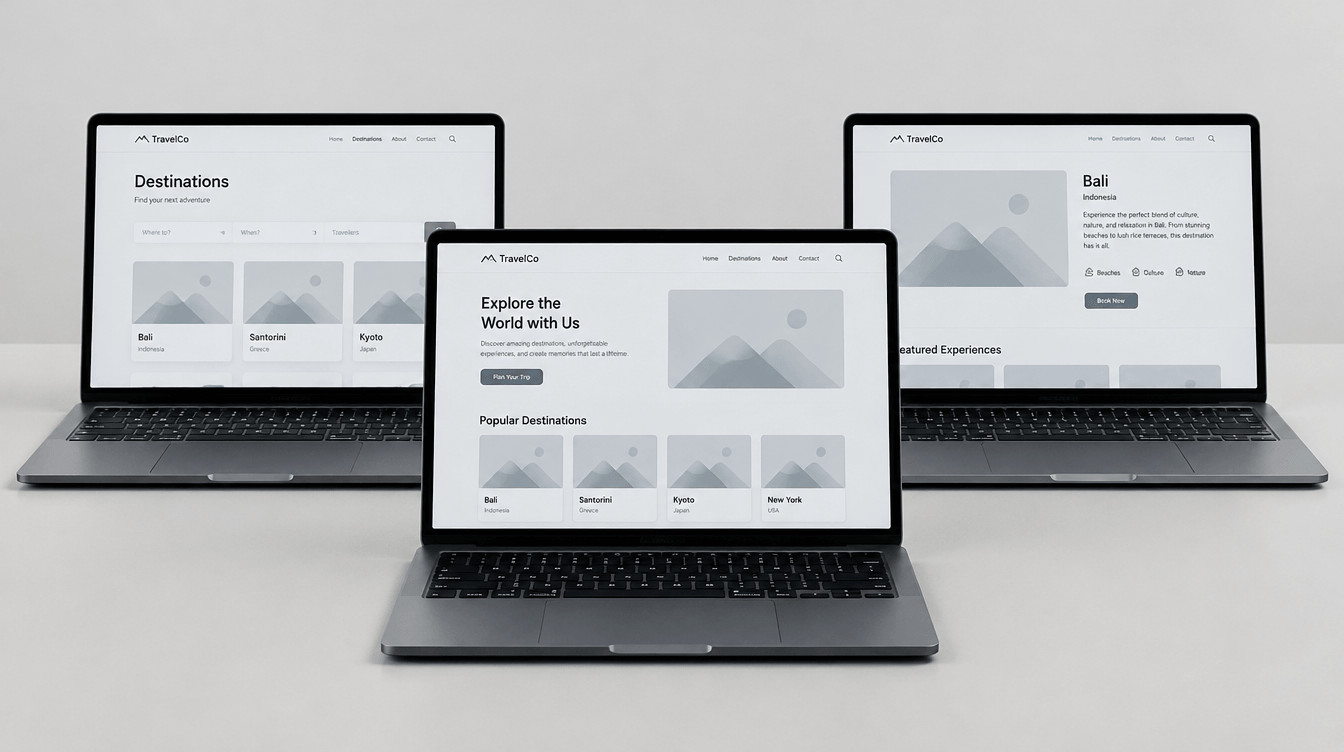
One of the biggest differences is whether the website uses an existing template or is designed specifically for the travel brand.
Templates reduce both design and development time and can be perfectly appropriate for a new business with limited requirements. The trade-off is that the website has to work within an existing visual and structural system.
Custom design takes the opposite approach. The website is created around the company's identity, customers and objectives.
This is particularly important in travel because perception sells. A company offering €5,000 tailor-made holidays can't afford to look indistinguishable from dozens of agencies using the same template.
The website starts shaping the perceived value of the trip before the visitor has even requested a quote.
Number of Destinations, Tours and Pages
Page count also affects the scope, but not simply because “more pages cost more.”
A travel agency might need dedicated pages for Greece, Italy and Spain, followed by destination-specific experiences, itineraries and travel guides. Each additional content type needs to be designed, structured and implemented consistently.
If organic search is important, these pages also become part of the SEO architecture. Instead of creating twenty disconnected pages, the website needs a logical relationship between destinations, experiences, articles and services.
A well-designed system can make future expansion considerably easier.
Booking Engine and Third-Party Integrations
Booking functionality is often the biggest variable in the budget.
A simple “Plan Your Trip” form is relatively straightforward. A live reservation engine connected to inventory and payment systems is not.
Travel companies may need integrations with booking engines, CRMs, newsletter platforms, payment providers, analytics platforms or specialist travel software. Each integration needs to be evaluated individually because connecting an existing service through a well-documented API is very different from developing completely custom functionality.
Before paying for an advanced booking system, ask whether your customers actually need one. For a high-value tailor-made travel agency, speaking with a consultant before booking might be an essential part of the service rather than unnecessary friction.
Content, Photography and Video
Travel websites are unusually dependent on visual content. You aren't simply explaining a service; you're asking someone to imagine themselves somewhere else.
Exceptional photography and video can therefore make an enormous difference.
If the agency already has a strong library of professional content, the website can be designed around it. If not, photography, video production, copywriting or content sourcing should be considered separately when establishing the overall project budget.
This is one of the costs businesses often forget when comparing website quotations.
Multilingual Website Development
Travel is international by nature, so multilingual functionality is common.
But translating a travel website isn't simply adding a language switcher. Navigation, URLs, metadata, page structures, forms and sometimes even content strategy need to work correctly across markets.
A Greek travel agency targeting customers from Germany, Switzerland, the UK and the United States may also need to communicate differently to each audience rather than simply translating the exact same copy.
The more markets and languages involved, the more content management and SEO complexity needs to be considered.
SEO and AI Visibility
A beautiful website that nobody discovers has limited commercial value.
Travel companies have significant opportunities to generate organic traffic through destination guides, itinerary content, travel advice, tour pages and other useful resources. That means SEO should influence the website's architecture from the beginning rather than being added after launch.
In 2026, discovery is also expanding beyond traditional Google search. Travelers increasingly research destinations and plan trips through AI-powered tools, making structured, clearly organized and authoritative content increasingly important.
The website should therefore provide a technical and content foundation that can support both traditional search visibility and emerging AI discovery.
Don't Forget the Ongoing Costs
The development quote isn't necessarily the complete cost of owning a travel website.
Depending on the technology and setup, you may also have recurring expenses for the domain, hosting, booking software, CRM, email marketing software, premium services, maintenance and technical support.
There are also marketing costs to consider. Building the website doesn't automatically generate visitors. SEO, Google Ads, social media, content marketing and other acquisition channels may require separate investment.
This is why we prefer looking at a website as business infrastructure rather than a one-off design expense.
The goal isn't simply to launch it. The goal is to make it useful for years.
At Webeleven, we design and develop fully custom websites around the business, its audience and its goals. Our experience with travel and tourism businesses gives us an understanding of the industry's particular challenges, from communicating destinations and experiences to international audiences to creating clear conversion journeys and building trust before the first enquiry.
A Real Travel Website Example: LINES
We worked with LINES, a premium travel agency based in Switzerland specializing in tailor-made travel experiences in Greece.
The project demonstrates why pricing a professional travel website based only on the number of pages doesn't make much sense. The work began with the business and the market, not with a template. We developed the brand identity and researched the Swiss and wider European audience before translating that positioning into the website experience.
The objective was to communicate elegance and trust while creating an emotional connection with travelers considering Greece. Custom design, carefully structured content, intuitive navigation and subtle interactive elements were all used to support that positioning.
For a business like LINES, the website isn't simply a digital brochure listing destinations. It's part of the product experience**.**
Before a potential customer ever speaks with the company, the website has already started answering an important question: “Can I trust these people to create an exceptional trip for me?”
That's where professional travel website design creates business value.
Cheap vs Expensive: How Much Should You Actually Spend?
There is no reason for a newly established independent travel consultant to invest €20,000 in a website if a €3,000 solution can achieve the business objective.
Likewise, it makes little sense for an established premium travel company selling high-value experiences internationally to save a few thousand euros by choosing a generic template that weakens its positioning.
The right budget depends on the economics of the business.
Consider your average booking value, profit margin, customer acquisition cost and expected lifetime of the website. If a €7,000 website generates only a handful of additional high-value bookings every year, the investment can make considerably more sense than a €2,000 website that generates none.
The cheapest website isn't necessarily the one with the lowest initial price. It's the one that delivers the best return over its useful life.
What Should Be Included in a Professional Travel Agency Website Quote?
Before choosing a web development partner, make sure the proposal clearly explains what you're actually paying for. Strategy and market research, UX and sitemap planning, custom or template-based design, development, mobile optimization, SEO foundations, analytics, accessibility, content management, booking integrations, testing, launch and post-launch support should all be discussed where relevant.
Ownership is equally important. You should know who owns the website, domain, design and code, whether there are recurring licensing costs, and what happens if you decide to work with another provider in the future.
A transparent proposal makes comparing two agencies considerably easier because you're comparing scope and value rather than two numbers at the bottom of a PDF.
-
Does a travel agency website need an online booking system?
Not necessarily. Many boutique travel agencies and luxury tour operators rely on personalized enquiries rather than instant bookings.
-
How long does it take to develop a travel agency website?
A simple travel agency website can take approximately 3–6 weeks to develop, while a fully custom website may require 6–12 weeks or longer. Projects involving complex booking systems, multiple languages or third-party integrations can take several months. The timeline also depends on how quickly content, photography and feedback are provided.
-
Is a custom travel agency website better than a template?
Both options have advantages. Templates can be cost-effective for smaller agencies with limited budgets, while custom websites offer greater flexibility in branding, user experience, performance and scalability. For premium travel agencies targeting international customers, a custom website can help communicate the brand's unique identity and differentiate it from competitors.
-
What are the ongoing costs of maintaining a travel agency website?
Beyond the initial development cost, travel agencies should budget for domain registration, hosting, maintenance, security updates and potentially booking software subscriptions. Depending on the website's complexity, ongoing technical expenses can range from a few hundred to several thousand euros annually. SEO, content creation and digital advertising are usually separate investments that help attract potential travelers and generate bookings.
Want a New Website for Your Travel Agency?
If you're planning a new travel agency or tour operator website, tell us what you're trying to achieve. We can help you define the right scope, functionality and investment before development begins.